Marine benthic diatoms from southern Brittany
(sublittoral zone)
°°°°°°°°°°°°°°°°°°°°°°°°°°°°°°°°°°°°°Foreword
Some samples were obtained on three stations 18 and 23 meters deep. In southern Brittany, the inferior limit of the sublittoral zone is around 15-20 meters deep. In the case of the 3 considered stations, no laminarians were present on the rocky surfaces in the vicinity of the sandy places where samples were collected. The limit for these macroalgae was some meters above. So, the 18-23 meters deep stations were in the upper circalittoral zone, as defined in biological terms (Hiscock & Mitchell, 1980).Collection of the samples and analysis
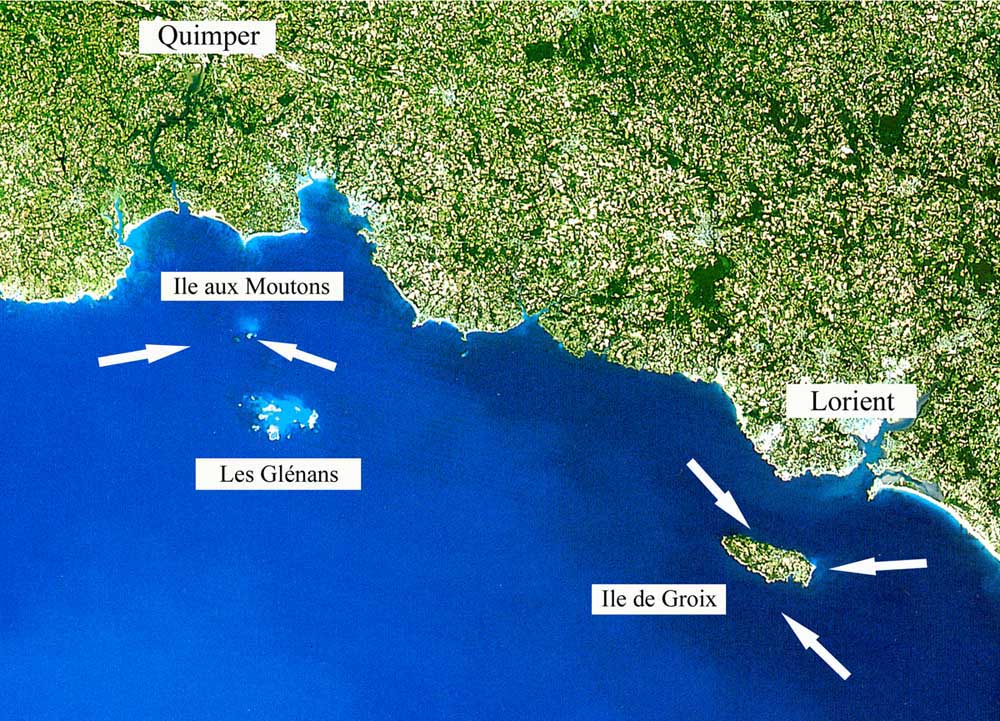
Twenty six samples were collected by diving during the may-august period, in 2003, 2004 and 2005, around the "Ile aux moutons" (southern Finistère) and around the "Ile de Groix" (Morbihan), between 5 and 23 meters deep (middle water spring tide). Samples were collected around this last island, every year, during july-august, from 2006 to 2011.In 2007, 8 carrots of were obtained to tentatively know the distribution of the species in the first millimeters of the sediment (see carrots).
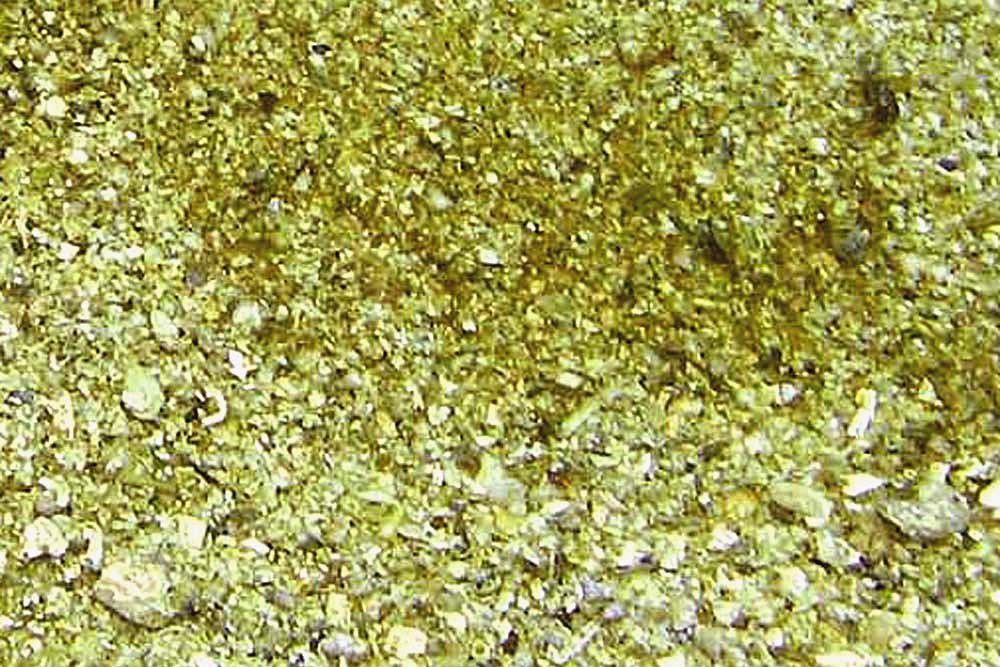
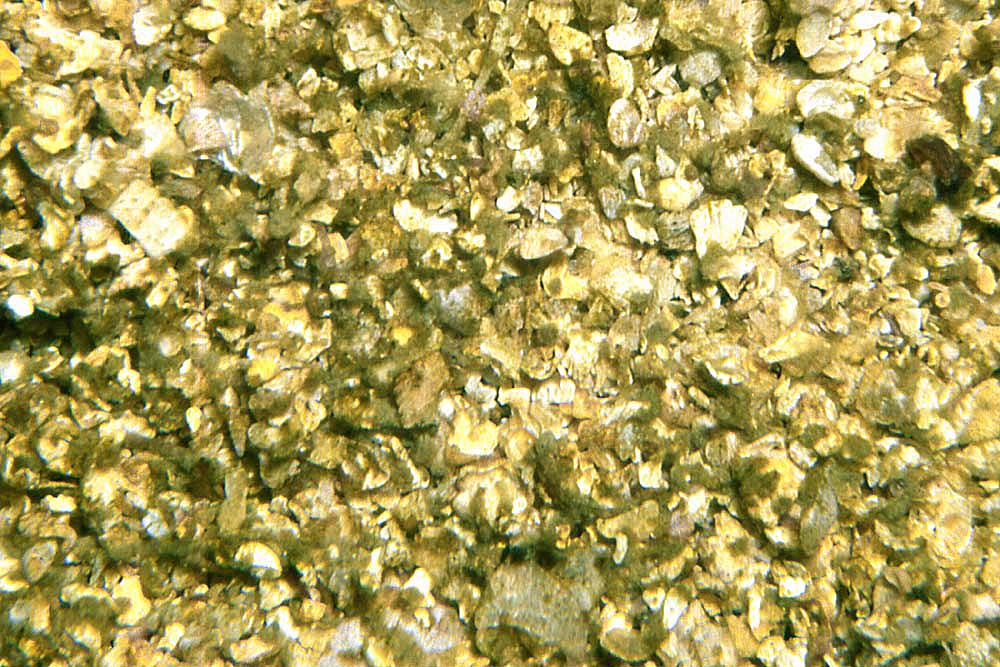
Using 50 ml Falcon tubes, the surface of the sand was scraped on a thickness of 3-4 mm. Samplings were done in the areas where a yellowish-braun film was present.
Brown area on a sandy bottom, due to the presence of a dense biofilm :

The biofilm is either homogenous or distributed in small patches :
After dilution with 0.5 volume of sea water, the samples were shaken deeply and after some differential sedimentations to separate the diatoms from the sediment, the frustules were treated and prepared according to Loir (2004a and 2004b ; see Bibliography).
The species present in each of the 2003-2005 samples were identified. For 10 samples, counting of about 1 000 valves has allowed to know the relative presence of every species.
To analyse the results, the 26 samples were gathered in the 6 following groups, according to their geographical origin and to the depth :
A : Groix, various sampling sites, depth : 5-7 meters (5 samples),
B : Ile aux moutons, various sampling sites, depth : 9-10 meters (3 samples),
C : Groix, one sampling site, depth : 9 meters (5 samples),
D : Groix, one sampling site, depth : 18 meters (4 samples),
E : Groix and Ile aux moutons, various sampling sites, depth : 20-23 meters (4 samples),
F : Groix and Ile aux moutons, various sampling sites with different granulometry of the sediment, depth : 6-14 meters (5 samples).
B : Ile aux moutons, various sampling sites, depth : 9-10 meters (3 samples),
C : Groix, one sampling site, depth : 9 meters (5 samples),
D : Groix, one sampling site, depth : 18 meters (4 samples),
E : Groix and Ile aux moutons, various sampling sites, depth : 20-23 meters (4 samples),
F : Groix and Ile aux moutons, various sampling sites with different granulometry of the sediment, depth : 6-14 meters (5 samples).
The samples collected in 2006 to 2011 were not analysed in detail, but only to list taxa which were not previously observed.
Charaterization of the diatom communities
A total of 512 taxa was observed (See the list of taxa). Twenty eight genera were represented by only one species. The genera represented by the greatest number of taxa were :Amphora Ehrenberg (and Halamphora (Cleve) Levkov) : 73 taxa,
Diploneis Ehrenberg : 47,
Cocconeis and Amphicocconeis Ehrenberg : 45,
Navicula Bory : 39,
Nitzschia Hassall : 37.
Diploneis Ehrenberg : 47,
Cocconeis and Amphicocconeis Ehrenberg : 45,
Navicula Bory : 39,
Nitzschia Hassall : 37.
Thirty four taxa were present in at least the half of the twenty six samples obtained in 2003-2005. Seven taxa were present in at least all the samples minus one of each of the 6 groups A to F. They are :
Cocconeis scutellum Ehrenberg (varieties scutellum, parva et minutissima) : 25/26 samples
Donkinia recta Grunow var. intermedia Peragallo : 25/26
Plagiotropis lepidoptera (Gregory) Kuntze: 24/26
Trachyneis aspera (Ehrenberg) Cleve : 24/26
Grammatophora oceanica (Ehrenberg) Grunow : 22/26
Podosira stelligera (Bailey) Mann : 22/26
Incertae sedis 4 : 23/26 (see Incertae sedis)
The number of taxa present in one
sample varied between 34 and 140 and the total number of taxa present
in one group varied between 175 (group F) and 243 (group C). Donkinia recta Grunow var. intermedia Peragallo : 25/26
Plagiotropis lepidoptera (Gregory) Kuntze: 24/26
Trachyneis aspera (Ehrenberg) Cleve : 24/26
Grammatophora oceanica (Ehrenberg) Grunow : 22/26
Podosira stelligera (Bailey) Mann : 22/26
Incertae sedis 4 : 23/26 (see Incertae sedis)
The three groups A, D and E correspond to samples collected at Groix (excepted one sample in group E), at 5-7 meters deep (A) and at 18-23 meters deep (D et E). For these groups, the number of taxa present in each group was equal to 211, 229 and 184 respectively and the mean number of taxa observed in one sample was equal to 73, 101 and 74 respectively.
In each of the ten samples for which a counting of the valves was carried out, one of the following genera was dominant, representing between 16 and 47 % of the taxa : Amphora, Diploneis, Donkinia, Navicula and Nitzschia + Bacillaria. The 5 dominant taxa in a sample represented together between 24 and 52 % of all the present taxa. Usually, these dominant taxa were not the sames in the different samples. Nevertheless, the following taxa were among the 5 dominant ones in several samples : Nitzschia spathulata (7/10 samples), Nitzschia linkei (4/10), Bacillaria socialis var massiliensis (4/10), Navicula arenaria var. rostellata (3/10), Donkinia recta var. intermedia (3/10) and Incertae sedis 1 (2/10; see Incertae sedis).
The species
Among the 512 observed taxa, 71 ones belonging to 16 genera were not identified. It was the same for 14 other taxa belonging to 13 non-identified genera . Pictures of some of these taxa are presented in :
Some taxa were photographed in vivo
About 15 observed taxa belong to the genera Actinocyclus, Coscinodiscus, Roperia and Thalassiosira, which are common in the plankton. Most often, they were rarely observed in the samples, with the exception of Actinocyclus octonarius which represented 9 and 10 % in 2 samples (C and D groups) and of Thalassiosira punctigera which was more seldom, but was present in 10 samples. As already observed (Hendey, 1964 ; see Bibliography), Actinoptychus senarius, Paralia sulcata and Podosira stelligera were often observed (in 11, 19 and 22 samples respectively) but they represented rarely more than 1 to 2 % of the valves.
Three samples collected in July 2005, at the east of Ile de Groix, at depths between 8 and 10 meters, contained numerous resting spores, which likely, after their morphology, corresponded to Chaetoceros or/and Bacteriastrum species.
The genus Mastogloia (at the Groix island)
Only 8 valves belonging to 4 Mastogloia taxa were observed in sixty one samples collected between 10 and 23 m depth around the Groix Island.
In samples collected in 2004-2011 and in 2013-2015 between 1.5 m and 7 m depth (charted depths), sixty five Mastogloia taxa were observed (Table). These data are presented in a paper which was published in "Cryptogamie-Algologie" (Loir, 2016). LM plates of the observed taxa were not included in the paper. Most of them are presented here: Mastogloia taxa at the Groix Island.
Conclusion
The diatom communities living on the sandy sediments present in the sublittoral zone of southern Brittany are characterized by the quasi-permanent presence during the may-august period of 7 taxa and they appear to be particularly rich in various species (about 500 taxa). This is due to the fact that nutrient substances such as phosphates and nitrates are there in greater concentration than in the overlying sea water, as organic materials (feces, dead invertebrates,...) and fragmented algae present on the sand quickly disintegrate and mineral components are freed by bacteria.
The critical depth for the growth of laminarians is at about 1% of surface illumination. Hendey (1964) has proposed that the depth at which diatoms live, normally does not exceed 10 meters. We know now that benthic diatoms possess, among various physiological adaptations to the environment, a capacity to heterotrophy which allows them to survive in a reduced light or in the darkness under some millimeters of sand (Hellebust & Lewin, 1977, Admiraal & Peletier, 1979, Riaux-Gobin, 1997 ; Bibliography). Our results point out that, at least on sand, the diatom communities are as rich in species at a depth of 18-23 meters (groups D and E, 229 and 184 taxa respectively) as at a depth of 5-7 meters (group A, 211 taxa) and that the 7 above-mentioned taxa are present in the whole height of the sublittoral zone.
About twenty species known from warm seas would be present in the sub-littoral zone along the coasts of Brittany. This would need to be confirmed.
Among the species that I have not named, some ones are likely new species for the science (see non-identified taxa). For instance, it is the case for six Incertae sedis taxa (see Incertae sedis) and for two taxa which should belong to the genus Achnanthidium .